
Factory communication guide
Best Walkie-Talkies for Factories in India
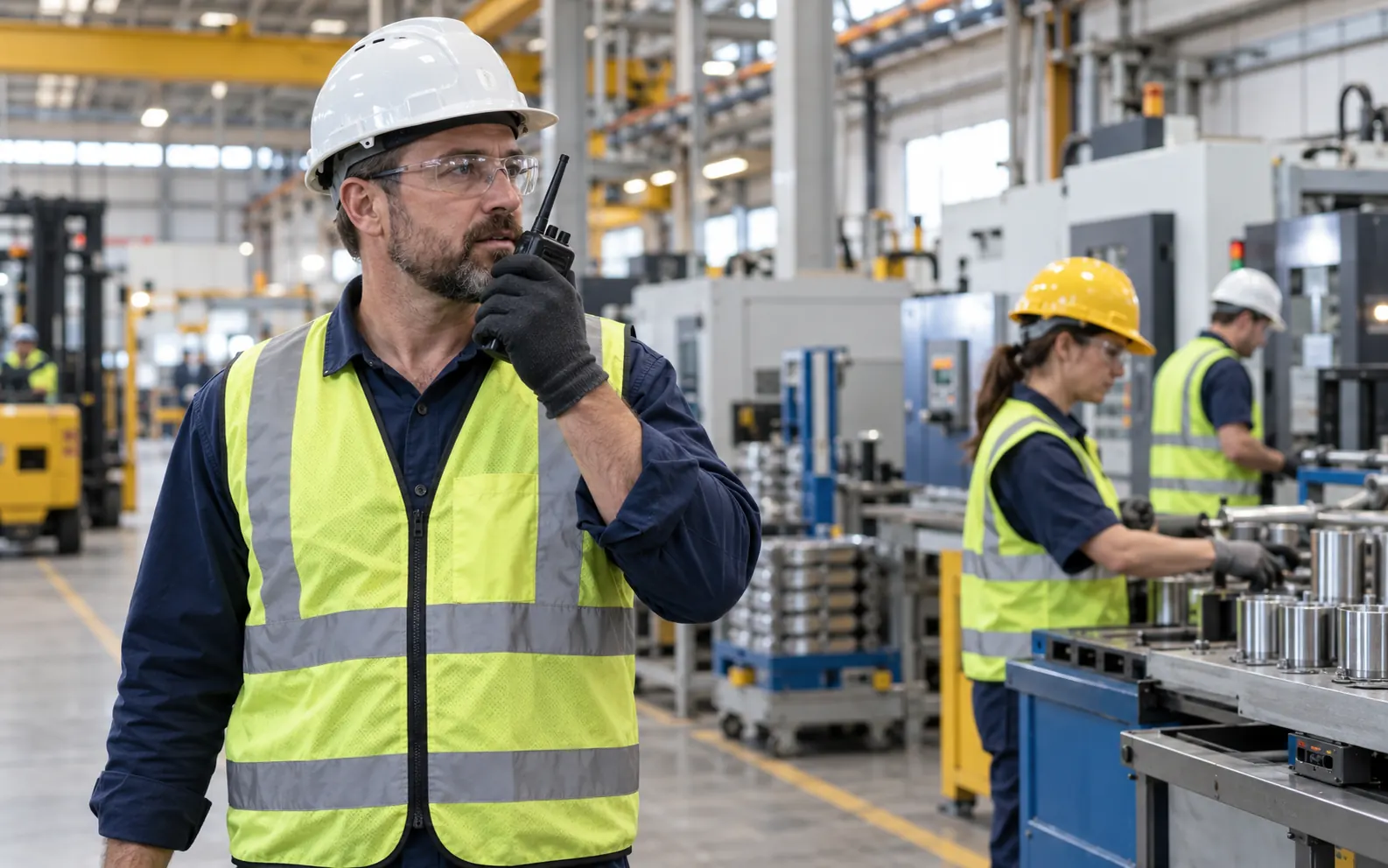
Factories usually need tougher communication planning than offices because machinery, concrete, steel, electrical noise, sheds, yards and shift teams all affect radio performance. The best walkie-talkie setup is the one matched to the factory layout, departments and coverage problem, not just the most powerful handset in a catalogue.
Communication problem
Why factory radio selection needs site-level thinking
A production supervisor may need to speak to maintenance near a machine line, security at the gate, stores near the loading bay and a plant head in another block. Mobile phones can be too slow for this kind of one-to-many coordination, especially when people are wearing gloves, moving around the shop floor or working in noisy areas.
Radio range inside a factory is affected by building material, floors, steel structures, machinery, partitions, outdoor yards, RF environment, radio power, antenna placement and whether a repeater is part of the system. No responsible supplier should promise a fixed range without understanding these site conditions.
Selection factors
Factory conditions that change radio performance
Coverage area
Map the actual communication path: shop floor to gate, production to maintenance, warehouse to dispatch, basement utilities to control room and outdoor yard to office. Long rectangular plants, metal sheds and multi-building sites often need a different approach from a single open hall.
Noise and audio clarity
Factories with presses, compressors, generators, fabrication work or packing lines should prioritise loud audio, clear modulation, suitable earpieces or speaker microphones and radios that remain usable with gloves or safety gear.
Department structure
Security, maintenance, production, EHS, housekeeping, stores and dispatch may not all belong on the same channel. Talk groups or planned channels keep routine updates from blocking urgent calls.
Durability and accessories
Daily industrial use makes batteries, belt clips, chargers, dust resistance, water resistance and replacement accessories important. A practical kit should include spare charging capacity and accessories for hands-busy roles.
Future expansion
A small unit may start with simple handhelds, while a growing plant may later need digital radios, additional channels, repeater coverage or a mixed fleet. It is worth choosing a path that can scale without replacing every device too soon.
Recommendations
Factory setups worth evaluating
For small factories and open workshops
License-free PMR446 radios may be sufficient where teams work across a compact area and do not need complex channel planning. They are usually easier to deploy, but their coverage is limited by the site environment and the 0.5W PMR446 class.
For larger plants, high noise or multiple departments
Professional analogue or digital radios are usually a better discussion point when the site has several departments, heavier usage, more demanding audio needs or expansion plans. Digital radios can support clearer fleet structure and better control depending on the chosen system.
For coverage gaps between sheds, floors or basements
If the issue is coverage rather than handset count, adding more radios may not solve the problem. A repeater-backed system, careful antenna placement or a digital radio design may be required after a site review.
For wide-area teams outside one factory campus
PoC radios may suit supervisors, transport coordinators or field teams who need push-to-talk across branches or routes. PoC generally depends on cellular, Wi-Fi or IP connectivity, so it should be evaluated differently from conventional two-way radio.
Decision table
Quick shortlist guide
| Factory condition | Radio approach | What to verify |
|---|---|---|
| Small single-floor workshop | License-free PMR446 handhelds | Good first option where range expectations are modest and the team needs simple push-to-talk. |
| Noisy production floor with maintenance and supervisors | Professional portable radios with suitable audio accessories | Prioritise audio clarity, ruggedness, battery planning and channel discipline. |
| Large factory with stores, dispatch, security and multiple sheds | Planned analogue or digital radio fleet | Separate departments using channels or talk groups; test coverage before final purchase. |
| Dead zones in basement, utility area or distant block | Repeater-backed system or redesigned radio network | A coverage check is more useful than simply increasing the number of handsets. |
| Managers travelling between plant, warehouse and city routes | PoC / LTE push-to-talk for wide-area coordination | Depends on cellular, Wi-Fi or IP coverage; compare honestly with conventional radio. |
Practical examples
Factory planning examples
Typical scenario: compact manufacturing unit
A 20-person workshop with one production area, a small stores room and one entry gate may begin with a small set of license-free radios for supervisor, stores, dispatch and security roles. The buyer should still test coverage near machines, office partitions and the loading point before standardising the fleet.
Example system design: multi-department factory
A larger plant may use one channel or talk group for production, another for maintenance, another for security and a common emergency protocol for supervisors. If stores, basements or a second shed are weak spots, the design may include a repeater rather than relying on handheld-to-handheld communication alone.
FAQs
Factory radio questions
Which walkie-talkie is best for a factory in India?
There is no universal best model. Small open workshops may be served by license-free PMR446 radios, while larger factories may need professional analogue or digital radios, accessories, channel planning or a repeater-backed system. The right choice depends on layout, materials, noise, users and required coverage.
Will a higher-power radio guarantee full factory coverage?
No. Real-world coverage depends on building material, steel structures, machines, floors, obstructions, RF environment, antenna position, radio power and system design. A site review or practical test is the safer way to assess coverage.
Are license-free radios enough for factories?
They can be enough for compact areas, light usage and simple teams. They may not be enough for large plants, basements, multiple buildings, high noise or departments needing separate channels and stricter communication control.
When does a factory need a repeater?
A repeater should be considered when handheld radios cannot reliably cover distant blocks, floors, basements, metal-heavy areas or large campuses. The repeater, antenna position and radio type should be planned together.
How many radios should a factory buy?
Start with roles, not headcount. Supervisors, maintenance, security, dispatch, stores, EHS and shift leads may need dedicated radios, while some teams can share devices by shift. Add spare batteries, chargers and backup units for continuity.