
Security communication guide
Best Walkie-Talkies for Security Guards
Security teams need radios that are simple under pressure, clear at gates and patrol points, durable through long shifts and organised enough for emergencies. The right choice depends on guard posts, patrol distance, buildings, basements, battery planning and whether supervisors need wider coverage.
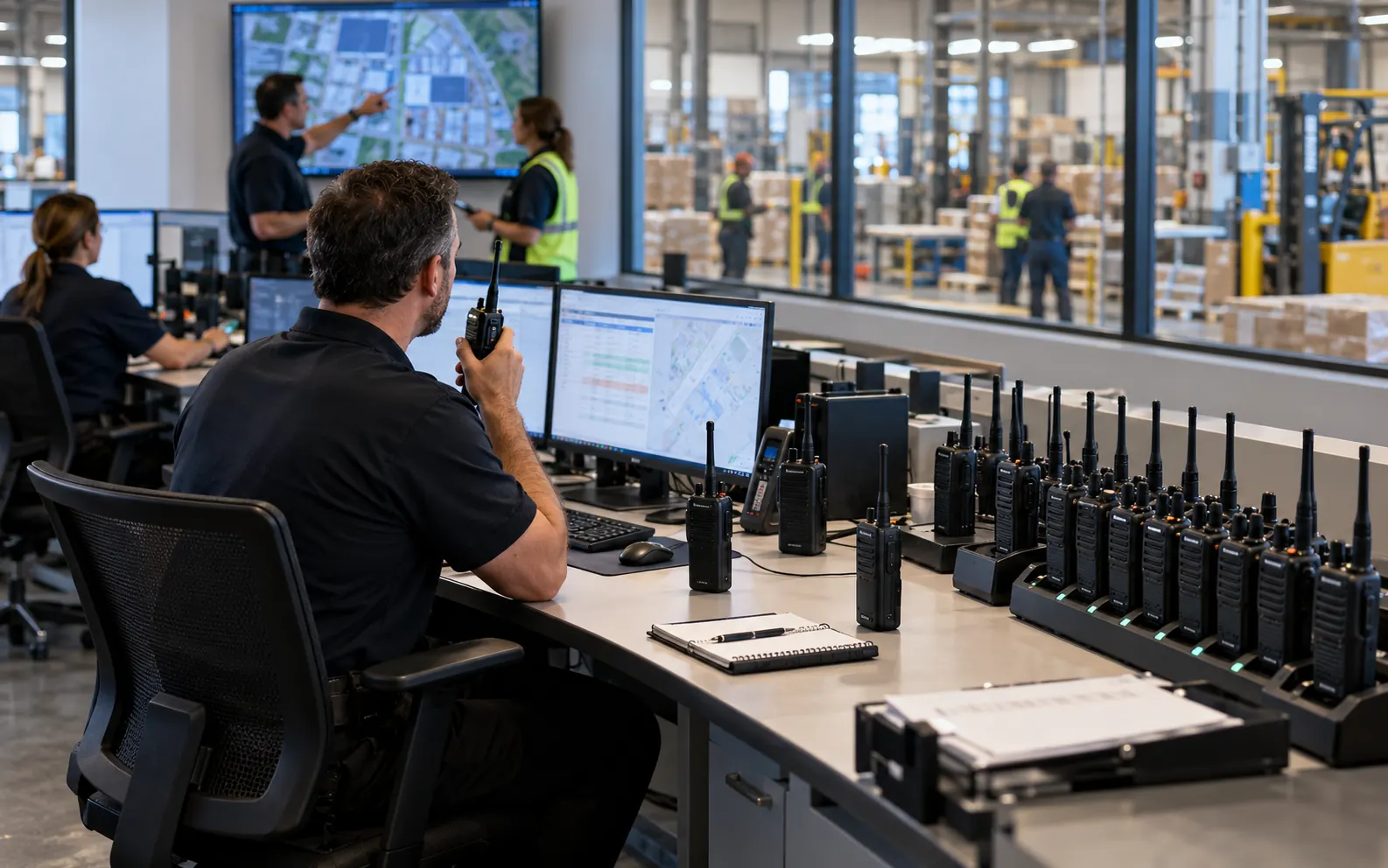
Guard response flow
Security communication fails when coverage and discipline are not planned
A guard at the main gate, a patrol guard behind the building and a supervisor in the control room need one-button communication. Missed calls or weak coverage can delay visitor handling, incident response or coordination with maintenance and management.
Security sites vary widely: a single gate, a multi-tower society, an industrial campus, a mall, a warehouse yard or a hotel. Radio range depends on walls, floors, terrain, obstructions, RF conditions, radio power and system design.
Security planning
What matters for gates, patrol and control rooms
Post-to-post coverage
Test every gate, patrol route, parking area, basement, stairwell and control room rather than assuming open-area range applies.
Battery life and shifts
Security radios often run continuously. Plan spare batteries, multi-chargers and radio handover routines for 12-hour or rotating shifts.
Emergency handling
Emergency buttons, clear channel rules and supervisor monitoring can be more important than extra features that guards rarely use.
Durability
Outdoor gates, dust, rain exposure and daily belt use require practical build quality, clips and replacement accessories.
Channel management
Large teams may separate gate, patrol, parking and emergency coordination to keep routine visitor calls from crowding urgent traffic.
Deployment options
Choose by post, patrol and escalation need
For small guard teams
License-free radios may work for compact premises, single buildings or short gate-to-office communication where traffic is light.
For industrial, mall or campus security
Professional radios with better durability, audio and channel planning should be evaluated for heavy daily use and larger guard teams.
For multi-building patrol coverage
If patrol guards lose signal at boundary walls, basements or remote blocks, a repeater or designed system may be required.
Guard deployment map
Security radio planning by site type
| Security layout | Radio setup to evaluate | Operational check |
|---|---|---|
| Two to six guards in one building | Simple handheld radio set | Check gate, reception, parking and back entry coverage. |
| Society, mall or factory guards | Professional handheld fleet | Plan channels, supervisors, chargers and spare units. |
| Patrol route crosses several blocks | Coverage-tested system | May need repeater support rather than just more handsets. |
| Field supervisors across sites | PoC option for wide area | Depends on cellular or IP coverage. |
Patrol examples
How security teams can structure radio use
Typical scenario: residential tower
Main gate, lobby, basement parking and patrol guards use radios with one supervisor monitoring. Basement coverage is tested before the same model is ordered for every tower.
Example system design: factory security
Security uses one channel for gates and patrol, while emergency escalation is handled by a supervisor channel or protocol. Remote yard coverage may be checked for repeater need.
FAQs
Security radio questions
What type of walkie-talkie is best for security guards?
For small premises, simple license-free radios may be enough. Larger sites usually need professional radios, proper channel planning and sometimes repeaters.
How many radios does a security team need?
Count posts and patrol roles, not just total guards. Add supervisor radios, spares, shift handover units and charging capacity.
Can one channel handle all guards?
Small sites can use one channel. Larger sites often need separate channels for gates, patrol, parking or emergency coordination.
Do security radios need earpieces?
Earpieces are helpful where discreet communication is needed, such as hotels, malls, offices and events.