
Warehouse communication guide
Walkie-Talkies for Warehouses and Logistics Centres
Warehouses need radios that reduce waiting between pickers, forklift operators, loading bays, supervisors and dispatch desks. The best setup depends on rack height, metal obstruction, dock layout, vehicle movement, shift pattern and whether the site is one hall or multiple zones.
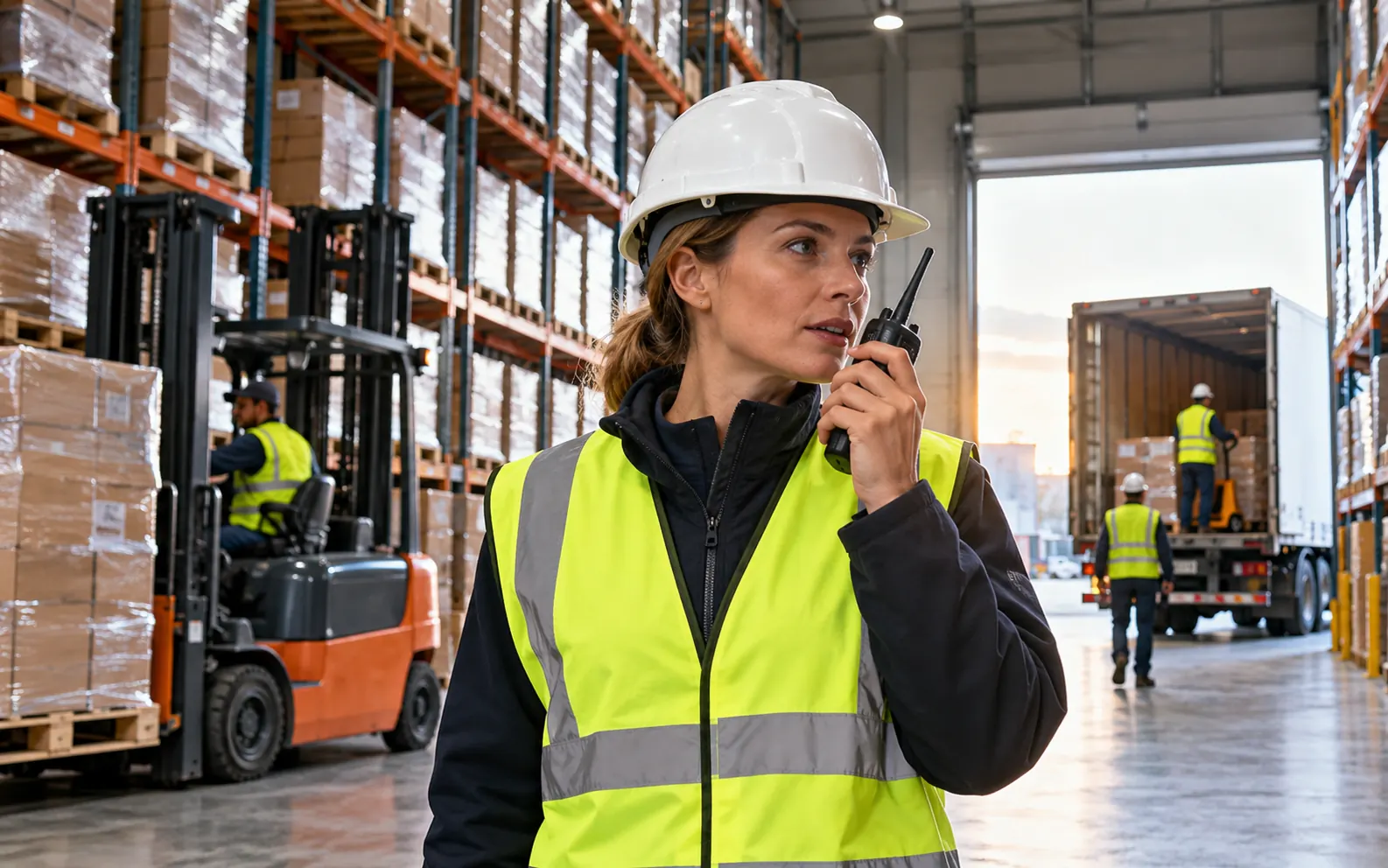
Movement and dispatch
Warehouse delays often start with small communication gaps
A forklift waiting for clearance, a picker checking stock, dispatch searching for one carton and a supervisor calling the loading bay can all lose time when communication is slow. Push-to-talk radios keep short operational questions short.
Warehouse coverage is affected by metal racks, pallet stacks, concrete walls, cold rooms, mezzanine floors, docks and moving vehicles. Range must be tested in working zones, not only at the office entrance.
Warehouse workflow
Where warehouse communication usually breaks down
Rack and aisle layout
Tall metal racks and dense inventory can block or reflect signal. Test the deepest aisles, not only open dock areas.
Forklift safety coordination
Radios support warnings and task coordination, but should fit safe operating procedures and hands-busy roles.
Loading bay traffic
Dispatch, goods-in and dock supervisors may need clear channels during peak vehicle movement.
Accessories
Speaker microphones, earpieces, belt clips, spare batteries and multi-chargers matter when users are moving all day.
Multi-zone operation
Large logistics centres may need zone-based channels or repeater support for distant areas.
Operational fit
Radio options by warehouse movement pattern
For small warehouses
License-free radios can be practical where the building is compact and the team needs simple coordination.
For busy logistics centres
Professional radios with planned channels are better for supervisors, forklift operators, dispatch, inventory and security teams.
For large racked sites or multiple sheds
Repeaters or a designed digital system may be needed where racks, distance or building divisions create dead spots.
Zone planner
Warehouse radio shortlist by activity
| Warehouse activity | Radio setup to evaluate | What to test on site |
|---|---|---|
| Compact stock room or small warehouse | License-free handhelds | Test aisles and loading point before bulk purchase. |
| Forklifts and active loading bays | Professional radios with accessories | Prioritise audio, battery and hands-busy use. |
| Multiple zones or high racks | Coverage-tested fleet | May require repeater support. |
| Transport coordinators on routes | PoC radios | Useful only where cellular/IP coverage supports it. |
Logistics examples
How radios support warehouse flow
Typical scenario: dispatch warehouse
Pickers, forklift operators and dispatch share structured channels so a missing item, blocked aisle or vehicle update can be handled immediately.
Example system design: logistics hub
A hub may use separate radios for inbound, outbound, inventory, security and supervisors, with coverage testing around racks, cold rooms and yard edges.
FAQs
Warehouse radio questions
Do warehouse racks affect walkie-talkie range?
Yes. Metal racks, stock density and building structure can affect coverage, so aisle testing is important.
Are radios useful for forklift teams?
They can help coordination, warnings and task updates, but must be used with safe operating procedures.
Do logistics centres need repeaters?
Some do, especially large sites, high-rack buildings, multiple sheds or weak dock-to-office coverage.
How should warehouse channels be planned?
Common groups include inbound, outbound, inventory, supervisors and security, depending on traffic volume.