
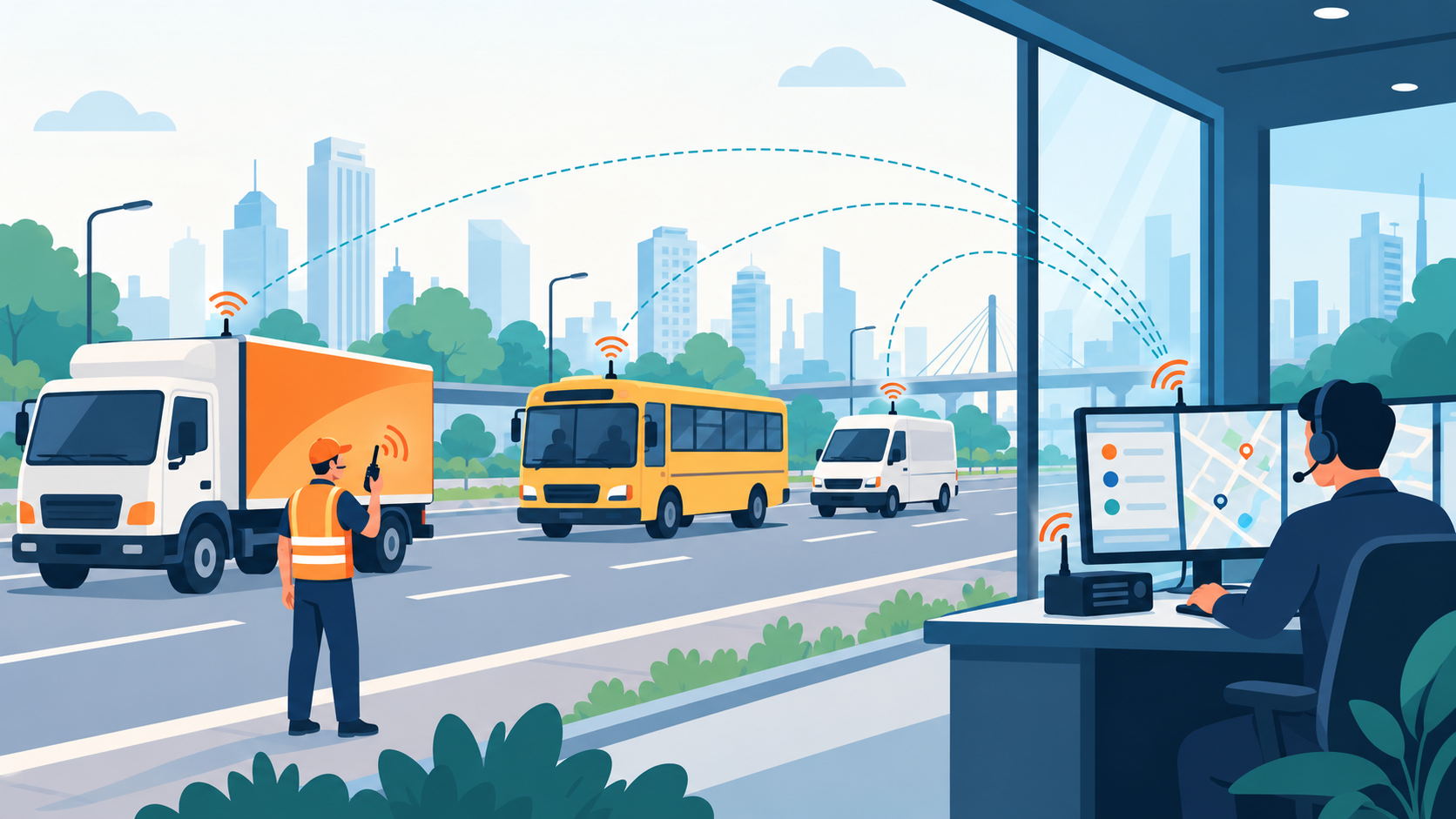
For transport companies, logistics operators, school bus fleets and field-service teams, communication between vehicles and a central control room is an important part of daily operations. Drivers may need route updates, dispatchers may need to contact several vehicles simultaneously, and supervisors may need to coordinate vehicles with staff working on the ground.
Mobile phones and GPS tracking systems are widely used for these tasks. However, vehicle-mounted two-way radios offer another communication option, particularly when teams need instant group communication without dialling individual numbers.
This guide explains how vehicle-mounted radios work, how they compare with handheld walkie-talkies and cellular communication, and what Indian fleet operators should consider before purchasing and installing a radio system.
What Is a Vehicle-Mounted Two-Way Radio?
A vehicle-mounted two-way radio, often called a mobile radio, is a communication device installed permanently or semi-permanently inside a vehicle.
Unlike a handheld walkie-talkie, which operates using a rechargeable battery and a compact antenna, a mobile radio normally connects to the vehicle’s electrical system and uses an external antenna.
A typical installation includes:
- A radio unit mounted inside the vehicle.
- A microphone for transmitting voice messages.
- A speaker for incoming communication.
- An external antenna, commonly installed on the vehicle roof.
- A suitable power connection to the vehicle’s electrical system.
The driver or authorised operator can communicate with a dispatcher, another vehicle or a group of radio users by pressing a push-to-talk button.
Professional vehicle radios generally support higher transmission power than handheld units, subject to applicable permissions. Their external antennas can also improve radio performance when correctly installed.
However, actual coverage depends on terrain, buildings, antenna placement, frequency, network design and other environmental factors.
Vehicle-Mounted Radio vs Handheld Walkie-Talkie vs PoC
Fleet operators have several communication options. The most appropriate choice depends on whether vehicles operate within a fixed site, throughout a city or across multiple regions.
| Feature | Vehicle-Mounted Radio | Handheld Walkie-Talkie | PoC / Phone App |
|---|---|---|---|
| Main use | Drivers and vehicle dispatch | Portable communication for staff | Communication over cellular data |
| Power source | Vehicle electrical system | Rechargeable battery | Device battery or vehicle charging |
| Antenna | Usually external | Usually integrated or attached | Cellular device antenna |
| Coverage | Depends on radio network design | Depends on radio and surroundings | Depends on cellular coverage |
| Group communication | Supported on configured systems | Supported on configured systems | Supported by compatible apps |
| Network dependence | No cellular network needed for conventional radio | No cellular network needed for conventional radio | Requires suitable data connectivity |
| Installation | Professional vehicle installation | Generally no installation | App or device configuration |
A vehicle radio is not automatically the best option for every fleet.
Handheld radios may be sufficient for vehicles operating inside factories, campuses or other compact sites. PoC systems may be useful for geographically dispersed fleets where reliable mobile data connectivity is available.
For more details, see our guide to PoC radios versus traditional walkie-talkies.
Why Fleet Operators Use Two-Way Radios Alongside Phones and GPS
Two-way radios do not have to replace mobile phones or GPS tracking systems. In many operations, these technologies serve different purposes.
Instant One-to-Many Dispatch
Consider a school transport dispatcher who needs to warn multiple drivers about a blocked entrance or a temporary route change.
Calling each driver individually takes time. With a properly configured radio system, the dispatcher can transmit one message to an entire group.
Similar situations arise in logistics yards, staff transport operations, security patrols and industrial vehicle fleets.
No Dialling for Routine Radio Calls
Conventional two-way radio communication uses assigned radio channels rather than making individual cellular calls.
Once the system is installed and authorised, ordinary radio conversations do not create cellular call charges for each transmission.
However, operators must still account for equipment, installation, licensing, maintenance and any network or service charges applicable to their system.
Communication Between Drivers and Ground Teams
Fleet coordination often involves more than drivers.
Warehouse staff, security guards, loading supervisors and maintenance personnel may need to communicate with vehicles approaching their work areas.
A compatible combination of vehicle-mounted radios and handheld walkie-talkies allows these teams to communicate on appropriately configured channels or talk groups.
Reduced Dependence on Cellular Coverage
Conventional radio systems can communicate without using a mobile phone network.
This may be useful at industrial sites, quarries, remote facilities or locations where cellular reception is unreliable.
However, radios also have coverage limitations. A radio network should be tested across the intended operating area rather than assumed to work everywhere.
Supporting Driver Safety
A fixed microphone or approved hands-free arrangement may reduce the need to handle a phone, but radio conversations can still distract drivers.
Drivers must follow applicable traffic laws and company communication policies. Non-urgent conversations should be handled after stopping safely. Hands-free systems should be used only where permitted and appropriate.
Typical Radio Network Setups for Vehicle Fleets
The network design determines which users can communicate and where coverage will be available.
1. Dispatcher Base Station and Vehicle Radios
A common arrangement places a fixed base station in the transport office or control room.
Vehicle-mounted radios communicate with the dispatcher over an authorised radio channel.
For example, a logistics company’s dispatcher may coordinate vehicles entering and leaving a distribution facility, communicate loading instructions and respond to operational delays.
This arrangement is especially useful when communication is centred around a depot or defined operating area.
2. Vehicle Radios and Handheld Walkie-Talkies
Some businesses need communication between vehicles and personnel working outside them.
For example, a construction site may have vehicle radios installed in site transport vehicles while supervisors and ground staff carry handheld radios.
When compatible equipment is configured correctly, users can communicate through the same radio network.
Compatibility must be checked across frequency bands, operating modes, channel settings and any digital-system requirements.
3. Repeater-Assisted Networks
Direct communication may not provide sufficient coverage across large industrial properties, hilly terrain or extensive fleet operating areas.
A repeater receives a radio transmission and retransmits it to improve coverage in suitable locations.
For wider city or regional operations, additional infrastructure, linked repeater sites or other network arrangements may be necessary.
A single repeater should not be assumed to provide city-wide coverage.
Fleet managers considering this arrangement can read our guide to two-way radio repeaters for large sites.
Analog vs Digital DMR Radios for Fleets
Vehicle-mounted radios are available in analog and digital configurations.
Analog Mobile Radios
Analog systems provide straightforward voice communication and may suit fleets with relatively simple dispatch requirements.
They can also be appropriate where an organisation already operates compatible analog infrastructure.
Digital Mobile Radio (DMR)
Digital Mobile Radio, commonly called DMR, is a digital radio technology used in professional communication systems.
Depending on the model and network configuration, DMR systems may support features such as:
- Individual and group calls.
- Multiple talk groups for different operational teams.
- Emergency alert functions.
- GPS location reporting through supported equipment and software.
- Call logs or communication records where supported by the system.
These capabilities are not universal. Buyers should check the exact radio model, software, network architecture and any additional equipment or subscriptions required.
For fleets planning to expand, the decision between analog and digital should consider existing infrastructure, compatibility and future communication requirements.
Features to Check Before Buying a Vehicle Radio
Fleet operators should evaluate practical requirements rather than selecting radios purely by appearance or advertised transmission power.
Audio clarity: Drivers should be able to understand messages despite normal vehicle and road noise.
Talk groups: Different departments may need separate communication groups, such as transport, security and maintenance.
Emergency functions: Some radios support emergency buttons or alerts. Confirm how these work and whether suitable monitoring procedures exist.
GPS reporting: Certain digital radios can transmit location information when combined with supported software and infrastructure. This should not be confused with a complete commercial fleet-tracking platform.
Call records: Logging and recording features depend on the radio system and associated applications.
Compatibility: Existing handheld radios, repeaters and base stations should be checked before purchasing new equipment.
Serviceability: Consider microphone replacements, spare accessories, installation support and ongoing maintenance.
Installing Vehicle-Mounted Radios
Correct installation is essential for reliable operation.
Antenna Placement
A suitable external antenna is commonly mounted on the roof or another appropriate vehicle location.
Its positioning affects signal performance. Vehicle body design, roof accessories, antenna type and nearby metallic structures must be considered.
Cable Routing and Power Connection
Professional installers should route cables securely, avoiding sharp edges, excessive heat, moving parts and areas where vehicle occupants could interfere with wiring.
The radio must have a suitable fused power connection that follows the equipment manufacturer’s instructions and the vehicle manufacturer’s requirements.
Installers should avoid interfering with airbags, vehicle electronics and safety systems.
Professional Testing
After installation, the radio system should be checked for communication quality, electrical compatibility and unwanted interference with vehicle equipment.
Fleet operators should document each installation for future servicing or vehicle replacement.
Licensing Requirements for Vehicle Radios in India
Professional vehicle-mounted VHF and UHF radio systems generally operate using frequencies that require appropriate authorisation.
In India, wireless frequency management and relevant licensing are handled through the Wireless Planning and Coordination (WPC) Wing of the Department of Telecommunications.
Before deployment, fleet operators should confirm the applicable requirements for their intended frequencies, equipment, locations and network configuration.
Equipment approval and permission to operate a radio system are separate matters.
Buying a radio does not automatically authorise its operation on a particular frequency.
Our guide to WPC radio licensing in India explains the general considerations in more detail.
Maintaining Vehicle Radios in Indian Conditions
Vehicle communication equipment may experience considerable heat, dust, vibration and moisture during daily operations.
Basic preventive maintenance should include:
- Inspecting antenna mounts and connectors.
- Checking microphone cables and mounting brackets.
- Looking for loose or damaged wiring.
- Keeping the radio and ventilation areas clean.
- Inspecting antenna seals after heavy monsoon exposure.
- Testing communication quality periodically.
- Arranging professional servicing when faults appear.
Fleet managers should maintain equipment records and encourage drivers to report communication problems promptly.
A Practical Rollout Plan for Fleet Operators
A phased deployment helps identify technical and operational problems before an entire fleet is equipped.
Step 1: Define Communication Needs
Identify the vehicles, dispatchers, ground teams and geographical areas that need coverage.
Step 2: Select a Suitable Network
Decide whether direct vehicle communication, a base station, repeaters or another network arrangement is required. Address licensing before transmitting.
Step 3: Run a Pilot
Install radios in a small number of representative vehicles. Test communication along real operating routes and at important work locations.
Step 4: Create a Channel Plan
Assign channels or talk groups for relevant departments, and establish procedures for routine and emergency communication.
Step 5: Train Drivers and Dispatchers
Explain push-to-talk operation, message discipline, emergency procedures, driver safety and fault reporting.
Step 6: Expand Gradually
Review pilot results, resolve coverage gaps and standardise installations before scaling across the fleet.
Vehicle-Mounted Radio Buying Checklist
Before finalising a purchase, confirm the following:
- Intended operating area and coverage requirements.
- Number of vehicles, dispatchers and handheld users.
- Analog or digital radio requirements.
- Compatibility with existing equipment.
- Need for base stations or repeaters.
- Required talk groups and emergency features.
- Availability of GPS or logging functions, if needed.
- Suitable antennas and professional installation.
- Applicable WPC permissions and equipment compliance.
- Maintenance, accessories and technical support.
- Successful pilot testing in actual operating conditions.
A properly documented requirement makes it easier to compare technically suitable systems and obtain accurate quotations.
Frequently Asked Questions
1. Are vehicle-mounted radios better than handheld walkie-talkies?
Not in every situation. Vehicle-mounted radios generally offer advantages in antenna placement, available power and permanent installation. Handheld radios provide portability and may be more practical for staff moving between vehicles and work locations.
2. Can school bus drivers communicate with a central transport office?
Yes, when the buses and transport office operate within a suitably designed and authorised radio network. Coverage should be tested along the actual bus routes.
3. Do vehicle-mounted radios work without mobile network coverage?
Conventional analog and DMR radios can operate independently of cellular networks. However, their communication coverage depends on the radio system and surrounding environment.
4. Can existing handheld radios communicate with vehicle-mounted radios?
Often, yes, provided the equipment is compatible and correctly configured for the same authorised system. Matching frequency bands alone does not guarantee compatibility.
5. Do fleet operators need a licence for vehicle-mounted radios in India?
Professional vehicle radio systems generally require appropriate WPC authorisation. Exact requirements depend on the system and intended operation. Confirm compliance before installation and use.
Conclusion: Choosing the Right Radio System for Your Fleet
Vehicle-mounted two-way radios can provide a practical communication channel between dispatchers, drivers and ground staff.
The right system depends on operating geography, number of users, communication requirements, existing equipment and applicable licensing.
A small pilot, professional installation and realistic coverage testing are more useful than relying on advertised range figures alone.
Electrosonic Technologies Pvt Ltd supplies professional two-way radio equipment for businesses across India, with offices in New Delhi and Mumbai. Its product portfolio includes Motorola, Kenwood, Icom, Aspera, Vertel and EVOX radio solutions.
Fleet operators planning a new communication system or expanding an existing installation can explore the available radio products and discuss suitable configurations.
For product enquiries and fleet communication requirements:
Phone: +91-9990696931
Email: info@electrosonictech.com
Website: https://electrosonictech.com
Related solutions
Useful next steps
Jump from this guide to the product types and support pages most buyers compare next.
Walkie-Talkies for Disaster Relief and Emergency Response Teams in India: A Practical Guide
A practical guide to walkie-talkies for disaster relief in India, covering floods, cyclones, emergency radio networks, batteries and licensing.
Read guideWalkie-Talkies for Disaster Relief and Emergency Response Teams in India: A Practical Guide
Walkie-Talkies for Exhibitions, Trade Fairs and Convention Centres in India
A practical guide to walkie-talkies for Indian exhibitions and trade fairs, covering hall coordination, coverage, interference, batteries and rentals.
Read guideWalkie-Talkies for Exhibitions, Trade Fairs and Convention Centres in India
Can Others Hear Your Walkie-Talkie? A Business Guide to Radio Privacy, Scrambling and Encryption in India
Can others hear your walkie-talkie? Learn how radio privacy codes, scrambling, digital radios and encryption affect business communication in India.
Read guideCan Others Hear Your Walkie-Talkie? A Business Guide to Radio Privacy, Scrambling and Encryption in IndiaNeed help choosing?
Share your site type, team size, and coverage needs. Electrosonic can help shortlist the right radios.
Contact us