
On this page9 sections
Steel plants, foundries and metal processing units operate amid heavy machinery, intense heat, dust and constant noise. From induction furnaces to rolling mills and dispatch yards, teams must coordinate quickly without compromising safety.
Industrial walkie-talkies provide instant push-to-talk communication without dialling numbers or relying on mobile applications. For integrated steel plants, secondary steel units, foundries and forging facilities, selecting the right system means evaluating coverage, durability and operational workflows.
Why Mobile Phones and Shouting Are Unreliable in Steel Plants
Extreme Industrial Noise
Furnace blowers, compressors and rolling machinery make shouted instructions difficult to hear, especially when workers wear hearing protection. Radios with loud speakers, noise suppression and compatible headsets improve intelligibility, but must be tested during actual operations.
Heat, Dust and Harsh Working Conditions
Radiant heat, metallic dust, vibration and rough handling challenge ordinary phones. Rugged radios offer dedicated push-to-talk controls and protective construction, provided their specified environmental limits are respected.
Large Sites and Signal Obstructions
Production buildings, storage yards and workshops may span extensive areas. Steel structures and enclosed rooms obstruct radio signals, while cellular reception can be inconsistent. Appropriate antennas and repeaters help address coverage gaps.
Shift Handovers
Incoming supervisors need updates on equipment status, maintenance and restricted areas. Departmental radio groups support timely communication alongside formal shift handover records.
Essential Communication Workflows in Steel and Metal Processing Plants
1. Furnace and Melt Shop Coordination
Blast furnaces, electric arc furnaces and induction furnace units require coordination between operators, supervisors and material handlers. Radios help communicate charging readiness, interruptions and movement restrictions. Hazardous operations still require approved procedures and positive acknowledgement.
For example, a furnace operator might report: "Melt Shop Control, Furnace Two charging equipment unavailable. Maintenance assistance required." The supervisor can acknowledge the call, assign a technician and communicate the resulting production delay.
Short messages identifying the equipment, problem and required action help prevent confusion between multiple operating furnaces.
2. EOT Cranes and Overhead Lifting
Electric overhead travelling (EOT) cranes move heavy loads, sometimes beyond the operator's direct view. Radios connect crane operators, designated signallers and ground teams for movement confirmations and stop commands. They supplement—not replace—approved signals, exclusion zones and lifting procedures.
A designated signaller might report: "Crane Three, loading bay obstruction identified. Hold movement." The operator should acknowledge the instruction before further action.
Plants should establish standard terminology, identify authorised signallers and prohibit conflicting instructions. Safety-critical lifting commands must follow the approved lifting plan.
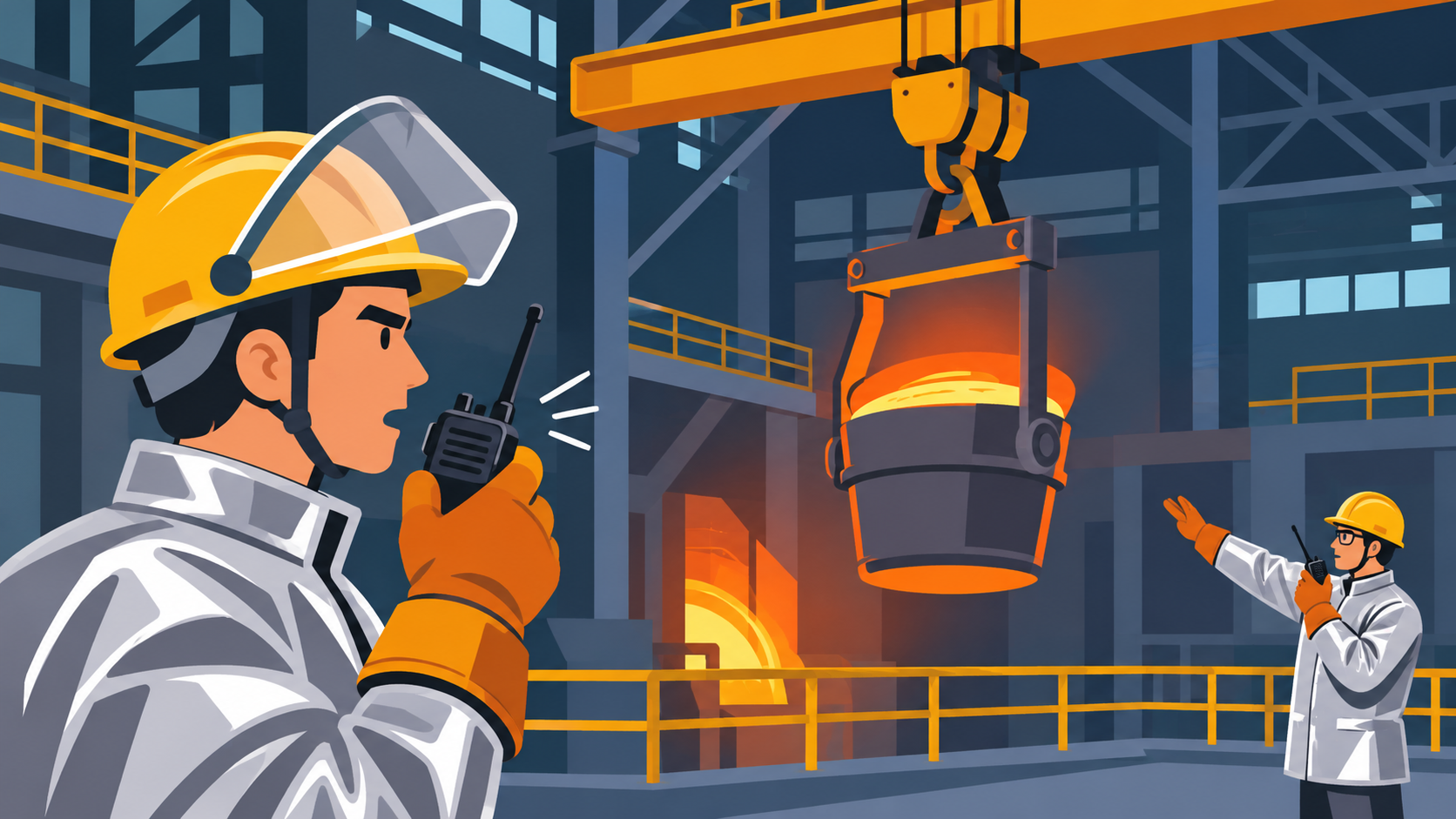
3. Ladle and Molten Metal Movement
Ladle transport demands disciplined communication about route clearance, readiness and emergency stops. Dedicated channels reduce unrelated traffic. Alternative signalling and radio-failure procedures must be established before movement begins.
A typical coordination exchange might begin with the transfer supervisor requesting route status. The designated ground team confirms whether the transfer path is clear, while the crane operator acknowledges readiness.
Movement must begin only after all required checks and authorisations are complete. Radio messages should identify the ladle, movement route and responsible personnel, avoiding ambiguous instructions such as "go ahead."
4. Rolling Mills and Forging Units
Rolling mills coordinate reheating, rolling stands, cooling beds and cutting sections. Forging teams coordinate furnaces, presses and material handling. Radios help report stoppages and abnormalities without leaving workstations.
For example: "Rolling Mill Control, Stand Four stopped due to abnormal vibration. Mechanical maintenance required."
This gives the control room enough information to notify maintenance, coordinate affected production sections and record the interruption. Operators should communicate restart readiness only after prescribed inspections and authorisations.
5. Maintenance and Breakdown Response
Failures involving motors, pumps, hydraulics or conveyors require prompt response. Maintenance talk groups help supervisors locate technicians and communicate repair progress without congesting production channels. Radios never replace isolation verification or lockout/tagout procedures.
During a breakdown, production may report: "Maintenance, conveyor motor at Bay Two has tripped." Maintenance can acknowledge, assign an electrician and report when inspection begins.
Once repairs are completed, the technician communicates equipment status to the authorised supervisor. Restart permission remains governed by the plant's established safety procedure.
6. Raw Material Yards and Dispatch
Scrap yards, weighbridges and dispatch gates need communication between supervisors, vehicle operators and loading teams. Vehicle-mounted radios may suit frequently moving equipment.
A yard supervisor can report that a loading bay is occupied, request another vehicle to wait or notify dispatch that material is ready for collection. Clear vehicle identification prevents instructions reaching the wrong driver.
7. Security and Gate Operations
Security teams coordinate visitors, vehicles, perimeter patrols and emergency access. A dedicated channel supports routine activity with a defined escalation path to plant control.
For example, gate security can notify dispatch about an arriving vehicle or inform emergency coordinators that an access route needs clearing.
What to Look for in Industrial Walkie-Talkies
Rugged Construction and IP Protection
Choose radios built for frequent handling, vibration and industrial exposure. Ingress Protection (IP) ratings describe resistance to dust and water under specified tests; IP67, for example, indicates dust-tight protection and temporary immersion resistance under defined conditions.
IP ratings do not establish resistance to furnace heat or molten-metal splashes. Verify operating-temperature limits, housing durability and accessory ratings. Compare options in this guide to factory walkie-talkies.
Procurement teams should also evaluate whether workers can operate the push-to-talk button and channel selector while wearing industrial gloves.
Loud Audio and Noise Cancellation
Evaluate speaker volume, microphone noise suppression and digital audio processing beside operating equipment. Office demonstrations cannot establish performance in a noisy melt shop.
During trials, ask workers to exchange actual maintenance and crane coordination messages. Check whether equipment identifiers, instructions and acknowledgements remain understandable.
PPE-Compatible Audio Accessories
Helmets, face shields, gloves and hearing protection affect usability. Consider heavy-duty speaker microphones, helmet-compatible headsets and industrial earpieces that do not compromise protective equipment. Review business radio products and accessories when specifying equipment.
Test cable routing, microphone positioning and comfort during normal movement. Accessories should remain secure without creating entanglement hazards around machinery.
Emergency Alerts and Man-Down Features
Some professional radios offer emergency buttons, lone-worker monitoring and man-down alerts. Availability depends on the model, configuration and infrastructure. These functions support—but cannot replace—established emergency procedures. See lone-worker safety and emergency radio alerts.
Before deployment, determine who receives emergency alerts, how they acknowledge them and what happens when the designated responder is unavailable.
Battery Life for Extended Shifts
For 8–12 hour shifts, check battery endurance against actual transmission patterns and accessory use. Plan spare batteries, multi-unit chargers and charging between shifts rather than relying on advertised maximums.
Numbering radios and maintaining a simple battery replacement schedule can help prevent discharged equipment from reaching incoming shift teams.
Digital DMR Versus Analog Radios
Analog radios offer straightforward communication for simpler installations. Digital Mobile Radio (DMR) supports configurable talk groups and, on suitable models, additional functions. Digital audio can remain clear under suitable signal conditions but may fail abruptly near the coverage limit. Select according to site needs and existing equipment.
For larger facilities, DMR talk groups can separate production, maintenance and security traffic while allowing authorised supervisors to monitor relevant departments.
UHF Versus VHF
UHF often merits evaluation around buildings and machinery; VHF may suit more open yards. Neither reliably penetrates every steel obstruction. Test both where appropriate, considering authorised frequencies, antennas and actual site geometry.
Coverage trials should include crane cabins, enclosed workshops and areas behind large metal structures, not just open production floors.
Comparing Communication Options for Steel Plants
| Factor | Licence-Free Radios | Licensed DMR Radios | PoC Radios |
|---|---|---|---|
| Communication | Direct radio | Digital, direct or repeater-based | Cellular or Wi-Fi data |
| Best fit | Localised operations | Departmental or plant-wide systems | Distributed teams with reliable data coverage |
| Coverage | Generally limited | Extendable using repeaters | Network-dependent |
| Features | Model-dependent | Professional audio; optional advanced features | Device/platform-dependent |
| Infrastructure | Usually minimal | May need repeaters and antennas | Data service required |
| Main limitation | Shared spectrum, limited coverage | Licensing and planning | Network dependency |
Licensed DMR often deserves consideration for demanding plants; PoC can complement conventional radios across geographically separated teams.
Planning Coverage Across Large Steel Plants
Survey furnace buildings, crane cabins, workshops, electrical rooms, rolling mills, yards and security posts. Advertised range alone cannot predict reliable coverage.
Repeaters and Antenna Placement
Repeaters can connect areas beyond direct handheld coverage. Results depend on antenna height, placement, feeder losses, interference and steel obstructions. Large facilities may need interconnected coverage zones. Explore repeaters for large industrial sites.
Department-Wise Talk Groups
A practical DMR setup may include:
- Melt shop and furnace operations
- Crane and material movement
- Rolling mill and forging operations
- Mechanical and electrical maintenance
- Raw material yard and dispatch
- Security and emergency coordination
Supervisors may need access to multiple groups. Define emergency escalation clearly rather than placing everyone on one busy channel.
For shift-based operations, keep departmental talk groups consistent across shifts instead of creating unnecessary separate channels for every shift. Assign radios by role, brief incoming workers on channel selection and transfer responsibility during handover.
WPC Licensing for Industrial Radios in India
Licensed two-way radios require appropriate Wireless Planning and Coordination (WPC) licensing in India. Confirm requirements before purchasing or deploying equipment. Electrosonic Technologies can guide teams through licensing considerations and system selection.
Steel Plant Radio Deployment Checklist
Before procurement, confirm:
- [ ] Identify departments, simultaneous users and shift requirements.
- [ ] Map buildings, yards and communication dead zones.
- [ ] Test radios during normal machinery noise.
- [ ] Evaluate UHF, VHF and repeater coverage.
- [ ] Check IP ratings, temperature limits and durability.
- [ ] Verify headset compatibility with helmets and PPE.
- [ ] Define talk groups and emergency escalation.
- [ ] Test battery endurance across complete shifts.
- [ ] Confirm WPC licensing requirements where applicable.
- [ ] Train users in etiquette, acknowledgements and emergencies.
- [ ] Plan charging, inspection, maintenance and spare radios.
- [ ] Complete acceptance testing before full deployment.
Frequently Asked Questions
1. Which walkie-talkies are suitable for steel plants?
Rugged professional radios with clear audio, suitable environmental ratings and verified site coverage. Select models based on operating conditions and departmental requirements.
2. Can walkie-talkies work inside steel buildings?
Yes, although steel structures can obstruct signals. Suitable antennas and repeaters may help; on-site coverage testing is essential.
3. Are digital radios better than analog radios for foundries?
DMR offers useful features for larger teams, while analog may suit simpler operations. Compare performance, coverage and workflow needs.
4. Can crane operators use radios while wearing safety equipment?
Yes, with approved compatible accessories that do not interfere with helmets, hearing protection or established crane signalling procedures.
5. How many radios does a steel plant need?
Count simultaneous users across shifts, departments and supervisors, plus emergency reserves—not just total employees.
Plan Your Steel Plant Communication System with Electrosonic Technologies
Electrosonic Technologies Pvt Ltd supplies professional two-way radios across India, with offices in New Delhi and Mumbai. Its portfolio includes Motorola, Kenwood, Icom, Aspera, Vertel and its own EVOX brand.
For an induction furnace unit, foundry, rolling mill or integrated steel plant, begin with a practical review of coverage, durability, workflows and safety needs. Contact the industrial radio solutions team for product selection and deployment enquiries.
Phone: +91-9990696931
Email: info@electrosonictech.com
Related solutions
Useful next steps
Jump from this guide to the product types and support pages most buyers compare next.
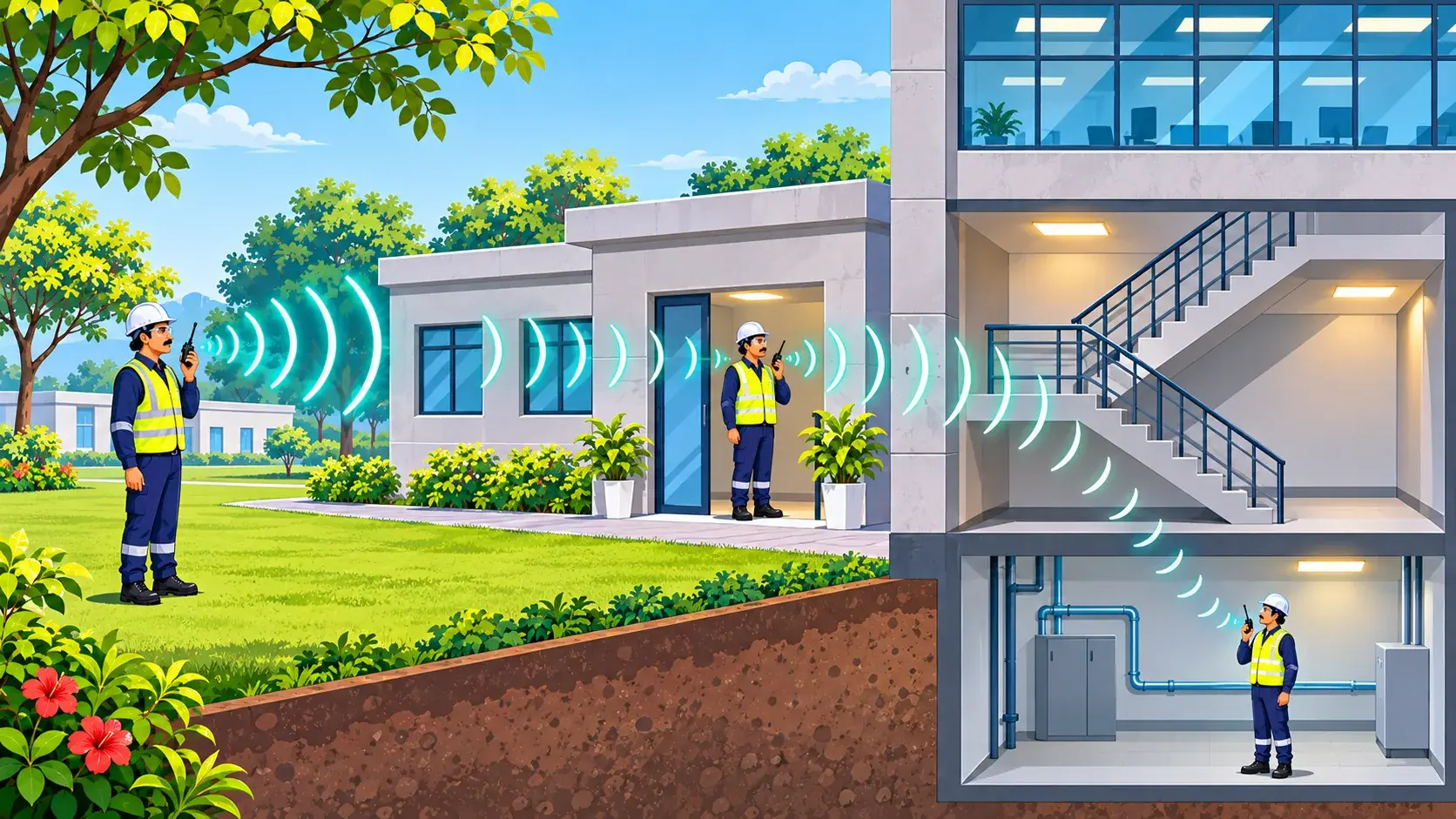
Walkie-Talkie Range Inside Buildings: Why Signals Fail and How to Improve Coverage
Learn why walkie-talkie signals weaken inside buildings, basements and factories, and how to improve two-way radio coverage for business teams.
Read guideWalkie-Talkie Range Inside Buildings: Why Signals Fail and How to Improve Coverage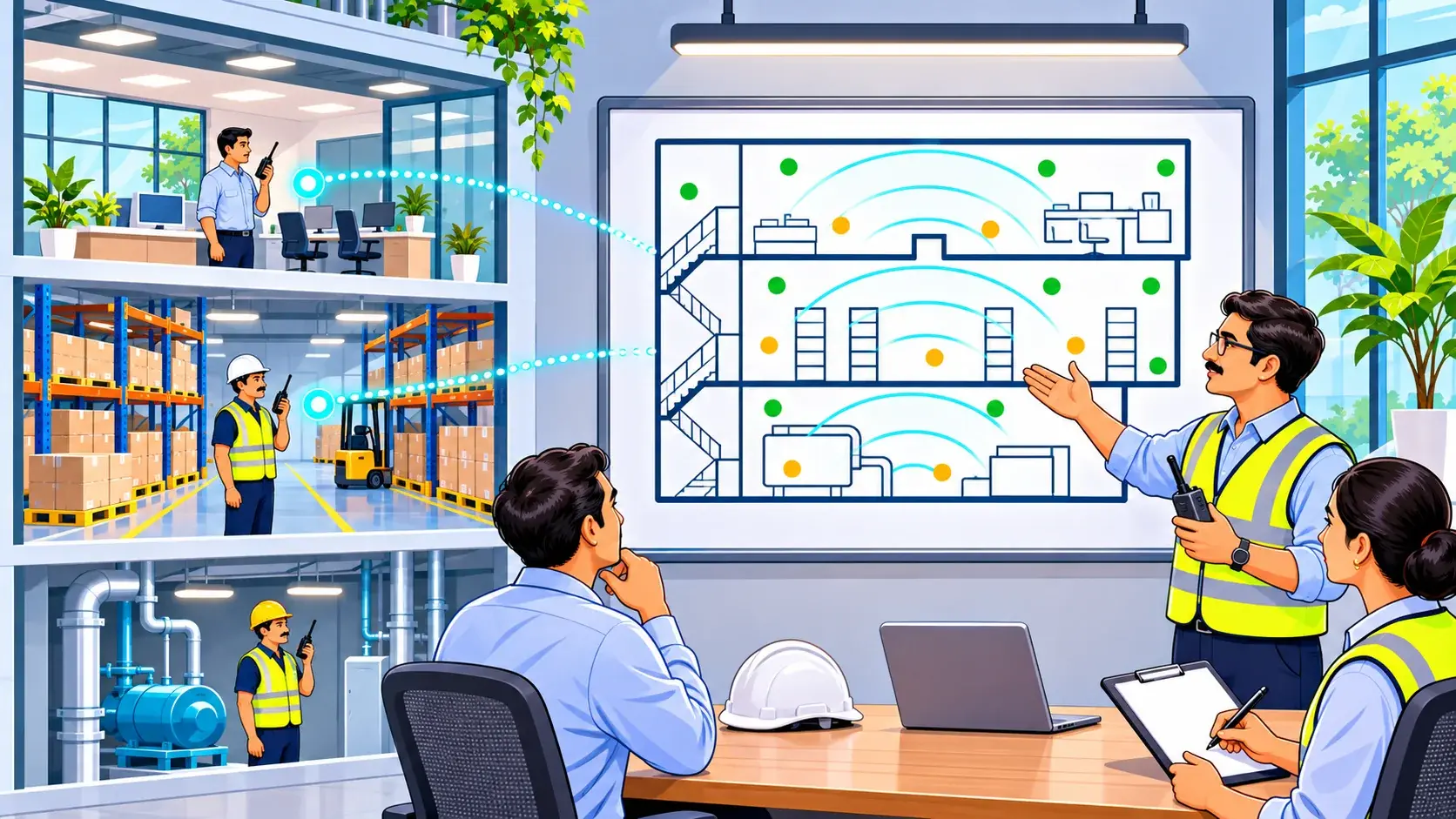
Best Walkie-Talkie Repeaters for Large Campuses and Industrial Sites
Plan repeater-backed radios for campuses and industrial sites. Assess coverage gaps, antenna installation, compatibility and support before adding more handsets.
Read guideBest Walkie-Talkie Repeaters for Large Campuses and Industrial Sites
Lone Worker Safety with Two-Way Radios: Emergency Button, Man-Down and Lone Worker Alerts Explained
Understand radio emergency buttons, lone-worker timers and man-down alerts. Plan monitoring, response procedures and practical checks for isolated staff.
Read guideLone Worker Safety with Two-Way Radios: Emergency Button, Man-Down and Lone Worker Alerts ExplainedNeed help choosing?
Share your site type, team size, and coverage needs. Electrosonic can help shortlist the right radios.
Contact us